Sunday, September 18, 2022

In His Grip


It was a spur-of-the-moment decision for a seminar title. Having seen it as a popular salutation in letters from friends, I thought it might perfectly fit the theme of the leadership seminar we were being asked to prepare for two different venues in Africa: In His Grip—Leadership Strength in an Insecure World.

It all began with a request by my friend, Austen Ukachi, Senior Pastor of He’s Alive Chapel in Lagos, Nigeria to return after seven years and conduct a second strategic planning review with his leadership team. He explained that the first review in 2016 had resulted in a new vision and mission along with inspiration that fueled planting daughter churches in Benin, Togo, Ukraine, England, Canada, and even Dallas, Texas, not to mention fifty other locations around Nigeria! But with COVID and other significant world trends, it was time to regroup and consider what the next seven years should bring. Knowing the executive consulting experience of my friend, Todd Ostlind, I asked if he might like to come along and help me out and was delighted when he accepted. Not wanting to waste a trip all the way to Africa, I also talked him into extending a second week so that we both could provide a leadership seminar for other Nigerian church leaders as well. That is how In His Grip was created.

The two of us took off from Spokane on August 30th bound for United Airlines’ new non-stop flight from Washington DC direct to Lagos, Nigeria. We never made the connection! Severe thunderstorms along the way resulted in a two-day delay. So, our strategic planning retreat had to begin with an all-day Zoom meeting conducted from our hotel rooms in DC followed by two more days of live presence once our eventual overnight flight got us there in-person. Surprisingly, the interruption was minimal, and the team seemed thrilled with the final three-day results of strategic review, SWOT analysis, and new goal creation. I can’t wait to see what these energetic, mission-minded folks will produce now in the next seven years!

After a lively Sunday at He’s Alive Chapel’s main campus, where both Todd and I were pressed into preaching roles plus attending a colorful, hour-long graduation of 100 young people who had completed their six-month discipleship course, it was time for our first of two In His Grip seminars—one in Lagos and one in Abuja, an hour’s flight north.

The motivation for creating the new seminar came from a sense that so much has changed in the world during the past three years that many in leadership positions simply may not know how to adjust adequately to the new normal that now defines the world. As our promotional flyer stated: Moral Relativism, Gender Identity, Radical Political Movements, Technological Tsunami—how should leaders navigate this time of global culture transition? We organized the two-day seminar around several plenary presentations by Todd on global trends and me on missional trends interspersed with small group discussions on local impact and application. We wrapped it all up with “Six keys for standing firm as God’s leaders in today’s world.”

We didn’t really know what to expect, but it certainly wasn’t the overwhelming affirmation received in both venues!

Averaging 125 participants each time, Todd and I were amazed at the passionate responses from young and old alike claiming they had been blown away both by the seminar content and our delivery style, which featured highly interactive PowerPoint presentations along with audience participation. “We normally go to seminars and simply listen to lectures,” several told us. “Having a chance to be so engaged in the subject matter is quite new for us. We truly have been challenged to consider how our leadership needs to change in order to remain relevant.”

Needless to say, we now have plenty of invitations for follow-up from this trip including continued consulting with Austen’s church, interaction with several church mission pastors, and dialogue with those who participated via WhatsApp social media. One thing is for sure, knowing how to respond with appropriate effort and wisdom is certainly going to require firmly remaining. . . In His Grip!

Monday, August 29, 2022

A Personal New Normal

 With the world becoming more and more a post-pandemic place, some surprising ministry opportunities have emerged for me. The bottom line is that the “semi” in semi-retired is becoming increasingly true! A short list of some really neat ministry involvements from the past few months should prove my point.

Last June, I returned to Africa for the first time in two years (the longest hiatus of international travel for me since 1982). After a great two-day planning retreat with the OC Africa team outside of Johannesburg, I flew on to Harare, Zimbabwe, where I had been invited to give a three-day seminar on steward leadership. Thanks to some great groundwork by Dr. Lovejoy Chabata, we had 62 participants who were all national-level church leaders, professors of theology, and presidents of theological institutions. The response was quite astounding. Many of the concepts I covered on becoming a faithful steward leader dovetailed with what these leaders call integral mission, a topic of keen interest for those wanting practical applications of African theology. This interest has now blossomed into more invitations for me to be involved with online training of teaching facilitators, followed by a possible second trip next year to participate in a national conference on the subject.

As some of you may remember, I spent much of the past two years putting my steward leader seminar into a downloadable form with both video lessons and printable workbooks.

Now, finally, I am starting to see the fruit of that labor. Last month, a young couple in Burkina Faso (who I have never met personally) got a hold of the course and decided to offer it to local pastors and leaders. Thirty-five participated, using the video series I had recorded in French. I jumped in only at the very end with a Zoom appearance to congratulate them on completing the course. Once again, I was quite amazed at their testimonies of personal impact. I understand one elderly lady was in tears as she explained how much the section on identity in Christ meant to her. Being single and therefore childless had brought her lifelong ridicule and condemnation from the African community that identifies successful womanhood only with being a wife and mother. Clearly, God was using the basic theology lessons of this course as important reminders to help many grow and mature in their understanding of God’s truth. Already the young couple there has been approached by seven other churches who want the course to be taught again.

On August 30, I am heading out on a second trip to Africa, this time to Nigeria and DR Congo. The first part of the trip will consist of three leadership events led in partnership with a good friend of mine, Todd Ostlind. We’ll be offering a strategic planning retreat for a large church denomination in Lagos followed by two-day seminars called In His Grip—Leadership Strength in an Insecure World in Lagos and Abuja. Then, I fly on alone to Kinshasa, DR Congo, where I will once again offer my steward leader seminar in an event hosted by Pastor Nubako Selenga of ReachAfrica. I look forward to being able to write another report on all that happens during these next busy weeks of travel.

I am definitely not interested in returning to the intense travel and teaching schedule I maintained for the past decade, but it certainly has been wonderful to be able to respond to these very rewarding opportunities for ministry. So, for now, I will accept that being semi-retired is the new normal for this current season of life!   

Monday, April 18, 2022

Lessons from an old Easter Hymn

But He was wounded for our transgressions, He was bruised for our iniquities; The chastisement for our peace was upon Him, And by His stripes we are healed. Isaiah 53:5  (NKJV)


As this Easter Day draws to a close, I find myself reflecting on this powerful verse. Certainly, it is the central theme of this Passion season—that as a result of Jesus Christ’s sacrificial suffering, crucifixion, and resurrection, the price for mankind’s redemption from sin and death has been fully paid. However, it is the word “healed” that fascinates me. What exactly was Isaiah referring to? Was it the healing of our souls? Or perhaps the healing of our broken relationship with God Himself?

I believe I found some answers to this question in the lyrics of an old folk hymn. It was one we used two nights ago to open our Good Friday service. I actually had the privilege of participating in a small sixteen-voice ensemble that presented it as the opening number for our time of contemplation and reflection. O Dearest Lord, Thy Sacred Head, is a simple, but moving number arranged by David Johnson from a melody taken from the Supplement of Kentucky Harmony, a 19th century collection of shape-note folk hymns. The lyrics were written by Father Andrew (also known as Ernest Hardy) in 1930. They are as follows:

O dearest Lord, thy sacred head
With thorns was pierced for me;
O pour thy blessing on my head
That I may think for thee.


O dearest Lord, thy sacred hands
With nails were pierced for me;
O shed thy blessing on my hands,
That they may work for thee.
 
O dearest Lord, thy sacred feet
With nails were pierced for me;
O pour thy blessing on my feet
That they may follow thee.
 
O dearest Lord, thy sacred heart
With spear was pierced for me;
O pour they Spirit in my heart
That I may live for thee.
 
What strikes me about these words is how they create a link between the wounds of Christ and specific healing I can experience. Far from being a broad, generalization, they help me understand how four fundamental aspects of my identity are forever transformed when I accept the gracious gift of Christ’s atonement.

 The first healing transformation is with my thinking. As Christ pours his blessing on my head, I find that my entire thought paradigm is changed. Instead of being trapped in self-defeating patterns of anxiety or unbalanced self-esteem (too high or too low), I am instead freed to think in new and noble ways as a steward of the Master of the Universe.

 The second healing transformation is focused on the work of my hands. Here, the change is not so much the activity my hands actually do (i.e. the particular type of career I’m in) but it is the reason for which that work is done that changes. The song says, “That they (my hands) may work for thee.” When I am conscious that what I am doing, mundane as it might be, is ultimately something that can bring glory to God, it changes everything.

 The third healing transformation is about my feet which symbolizes the trajectory of my life. Following the Master, wherever He may lead, can very often change the direction of my professional pursuits, as has happened multiple times during my own career. Those sorts of major shifts can be daunting and even debilitating, if done strictly within the context of our own perspective. But when I know the “bend in the road” has been prescribed by the One who told me to follow him, I need not be alarmed. I need simply trust and obey and look with anticipation what new thing He has in store around the corner.

 The final healing transformation is about my heart and the ultimate essence of my life-purpose. To “live for thee,” is to let my identity as a Christ-follower take precedence over all other demands and callings. I must never forget, as Steven Curtis Chapman’s song lyrics so aptly state, “God is God, and I am not.”  However, I am God’s child, His servant, and His steward and within these phenomenal relationships, I can find true and lasting life-purpose.

 One final image this song offers comes from the words pierced and poured. It is from Christ’s wounds experienced through piercing that blessing and transformational power is poured out on someone like me. It makes me think of the  anointing that took place in the Old Testament, such as this one recorded in 1 Samuel 16:13 - So Samuel took the horn of oil and anointed him in the presence of his brothers, and from that day on the Spirit of the Lord came powerfully upon David.

 That’s why I like the imagery of this historic hymn. It helps me envision Christ as God’s “horn” or vessel full of unquenchable resource that had to be pierced in order that the oil of blessing could be poured out on me—on my head, my hands, my feet, and my heart.

 May the hope of this blessing and potential renewal encourage you and me alike as we move ahead into the rest of this year remembering these lessons from an old Easter Hymn.


Thursday, December 23, 2021

Let's Steal Christmas Back from the Grinch

 I have a theory that the Grinch who stole Christmas is back again! He's back not to steal Christmas like he did the last time, but to steal from us the real reason for the season.

If you remember from Dr. Suess's famous children's book, or maybe the Broadway musical, the last we heard of the Grinch is that he got reformed. When he realized that taking away everyone's presents and holiday treats didn't stop Christmas from happening, he changed his mind and went back to Whoville to give everything back and join in the celebration with them. As Dr. Suess puts it:

Then the Grinch thought of something he hadn't before!
"Maybe Christmas," he thought, "doesn't come from a store."
"Maybe Christmas...perhaps...means a little bit more!"


And he brought back the toys and the food for the feast
And he. . . he himself. . . the Grinch carved the roast beast.

But today, my sense is that the Grinch is more subtle. He's learned that he doesn't need to steal Christmas the way he did last time by taking away all the presents, food, and things people used to celebrate the holiday. Instead, all he has to do is divert people's attention from why Christmas was established in the first place. And if I'm correct, then I would say the Grinch has done a masterful job of it this particular year. First we have the supply chain issues that creates anxiety about being able to adequately shop for those Christmas gifts. On top of that, there is the global COVID pandemic along with national mandates plus anxiety about deep systemic problems in our societies.  Is it any wonder that our "Silent Night, Holy Night" has been shattered with terror, trauma and tears?

So--I believe it's time to steal Christmas back from the Grinch. And in the spirit of Dr. Suess, here's my idea of how we should do it:

Let's Steal Christmas Back From The Grinch 
by Jon Lewis
The Grinch has come back with some new Grinch-like zeal
And now knows that instead of a thing he must steal,
All he must do is change the main reason
That people like Christmas during this winter season.
Today Grinch thinks Christmas could maybe be stopped
When folks forget Jesus with stuff they have shopped,
That tinsel and lights and toys to be awed
Will make us all think that there’s really no God.
Or if that doesn’t work to bring a pandemic,
Or cause us to worry about problems systemic.

But the Grinch doesn’t know that God is no stranger
To those who believe Christ came in the manger.
So, this year let’s show Grinch that Christmas IS more
Then expensive gifts we buy at the store
Or then trying to make the whole world happy
With man-made ideals that are often quite sappy,
And focus instead on the Bethlehem story
Where shepherds and angels gave God all the glory,
For the coming of him of whom prophets did tell,

Christ, God Incarnate, our Emmanuel!


May God give you some fresh, new reasons to truly have a. . .

Merry Christmas!

Thursday, December 16, 2021

Why Christmas Is Important

Recently, I was asked by my church to teach a couple of adult Sunday School lessons on the topic of Why Christmas Is Important. As usual, the process of thinking through this subject was more beneficial for me personally than probably for anyone else who sat in my class. It also brought new meaning to the Advent readings my wife and I have been doing this year. It has reaffirmed for me that despite of the commercialization that takes place around this holiday season, especially in our American culture, the core of Christmas is still a powerful testimony of Missio Dei, God’s great mission to reclaim a fallen world and reestablish relationship with all mankind. 

With that in mind, here are nine reasons to consider why Christmas is important, divided up (a bit like Dickens’ three ghosts) into Christmas Past, Present, and Future: 

From Christmas Past 
  1. The Fulfillment of God’s Promises – It reminds us that Christ’s birth and subsequent life among men, is the fulfillment of hundreds of prophesies found throughout the Old Testament. 
  2. The Incarnation: God becoming Man—It is the single most important event since the beginning of the universe, the moment when the Creator Himself chose to become part of His own creation. 
  3. The Means of Redemption—The Christmas event of Incarnation was the only means by which God could bring about His act of redemption and reconciliation for the entire human race. 

From Christmas Present 
  1. A Celebration of Joy—In a world full of despair and discouragement, it stands out as a celebration of joy! Regardless of cultural tradition or even secular application, it stands out as one event with a primary purpose of bringing gladness and joy to as many people as possible. 
  2. Global Missional Impact—In a world divided and fragmented, the “good tidings of great joy” of Christmas is a message directed at ALL people everywhere in the world. It therefore is the most global “missions” event of the entire year as God’s values of hope, peace, joy, and love are passed around and shared worldwide. 
  3. Original Model of Gift-Giving—In a world obsessed with self-centeredness, it declares and models God’s generosity to Mankind through the gift of his own Son and thus becomes the ultimate model of selfless gift-giving with a focus on people other than ourlselves. 

From Christmas Future 
  1. Renews our Expectations—It reminds us that Jesus not only came to be with us 2000 years ago but has promised to come again. 
  2. Restores Hope for Eternity—It further helps us remember that Jesus will not only come again to establish His Kingdom, but now, as part of his family, we have the prospect of spending Eternity in God’s presence. 
  3. Refreshes our Commitment to being Prepared—As we wait for His second advent, it helps us focus on Christ’s mandate to be prepared for his return no matter when it might be. This, in turn, demands that we need to stay committed to unity, faithfulness, and being blameless and holy, as Paul so aptly states in Ephesians 1:4 and Colossians 1:22. 

 All of these reasons certainly give new meaning to the messages embedded in Christmas Carols whether sung in church sanctuaries or a Home Depot plumbing aisle or a Beijing MacDonald's. Those messages are still powerful and clear and worth singing again and again, such as: Joy to the world! The Savior reigns! or Cast out our sin and enter in, be born in us today, or Oh tidings of comfort and joy. . .  because Christ our Savior was born on Christmas Day. 

 All good reasons to reaffirm why Christmas is important. 

And all good reasons, even this year, to truly have a . . . 

Merry Christmas!

Wednesday, October 20, 2021

Stewarding a Fallen Planet

Enroute during a road trip from California to our home in Spokane, Washington, my wife and I passed through areas of the Shasta and Klamath national forests that had been devastated by wildfires just a few months before. It was shocking and so sad to see the extent of the total annihilation of all plant life in some of the most verdant forests of America. Even Mt. Shasta looked somber, its pristine white glaciers covered with the dark gray soot from those same fires. At one place along our route, however, I was impressed to see workmen spraying wide borders on both sides of the road with what appeared to be mulch and grass seed. “Wow,” I commented to my wife, “they must be attempting to reseed the burned area to get something growing again as quickly as possible.”

That got me thinking about the question: how should we steward a world that is fallen? It’s one thing to preach Creation Care where there is blatant human abuse of the environment, such as water pollution, toxic emissions, or oil spills. But what does it mean to be a steward of our world when Creation itself  appears to cause the devastation, such as earthquakes, tsunamis, and lightning strikes that spark forest fires?

When God gave Adam the mandate in Genesis 1:28 to subdue and rule over all He had created, He certainly knew that soon it would become a fallen world, one that would also produce thorns, thistles, and tsunamis. After Adam and Eve’s tragic decision to disobey their Creator, God restates the responsibility of caring for the earth, except now He adds the stark reality that working the ground will mean “painful toil” and “by the sweat of your brow you will eat your food . . .” (Gen 3:17-19). This indicates that just because we live in post-fall planet, that doesn't change God's expectation that we are supposed to tend and care for it.

So again, I ask, how should we approach our stewarding of a fallen world, especially when it means responding to devastation that wasn’t really our fault? Let me suggest three responses:

1.       With a sense of obedience. We should be committed to Creation Care, not because our efforts are going to make or keep our world perfect, but simply because God told us, His chosen stewards of this planet, to do so. It’s easy to think that there is little point in working hard at something over which we don’t have ultimate control. But isn’t this also true of our responsibility in stewarding relationships with other people, such as our spouse or our children? Our stewarding efforts of encouragement and guidance will never make them perfect, but that doesn’t mean we should cease our responsibility to be the partner or mentor they may need. So also with the environment. We need to do our best to fulfill our Creation Care mandate regardless of the ultimate outcome—simply out of obedience to our Master. 

2.       With a readiness to endure hardship. Living in a fallen world, by definition, means facing pain and trial. The New Testament is full of reminders about this, but also matches them with ready exhortations to endure through them as a means of learning, building character, and becoming strong.  If it works for building character and spiritual maturity, it should also work for building greater understanding and wisdom in how better to provide Creation Care. We should steward our fallen planet despite how challenging that task might be. 

3.       With a commitment to renewal. If there is one quality of God that repeatedly is illustrated in Scripture, it is His heart for renewal. Israel’s history of rebellion and betrayal is constantly matched by God’s readiness to restore and renew those who are repentant. Without question, our Master is a God of second chances. As His stewards, we therefore need to imitate this same commitment to renewal in our stewarding of our environment. Just as sure as our own personal loyalty to God will falter from time to time, this fallen world will surely demonstrate its tendency toward self-destruction. As planet caretakers, we need to simply accept this and follow our Master’s example with a commitment to restore and renew—again and again.

I doubt those workmen beside the road were being motivated by a biblical mandate for their reseeding project; but nonetheless, they were demonstrating the work of an intentional gardener. I thank God for their reminder to me that, despite the devastations we will surely see across our fallen planet, there are always good reasons for God’s faithful stewards to care for His Creation. 


Soot-covered glaciers on Mt. Shasta, burned forests, and green reseeding effort


Tuesday, March 23, 2021

A Birthday Blog

 Teach us to number our days aright, that we may gain a heart of wisdom. Psalm 90:12 (NIV 1984)

Today, March 23, 2021, is a perfect day to reflect on this verse. Why? Because today is my 70th birthday! On such a life milestone as this, I can’t help but review with gratitude the phenomenal opportunities God has packed into my life until now and then ponder what He might still have in mind for me in the years ahead. Whatever the case, today is a good time to consider just what it means to “number our days aright” and be a good steward of time.

I have enjoyed teaching about the stewardship of time in my Africa Steward Leader seminars during the past decade, and I have often used the analogy of looking at the squares on a calendar as a series of empty cardboard boxes. God gives every single person the same-sized box each day of our lives—a twenty-four-hour-sized box. No favoritism here! It doesn’t matter if you are wealthy or poor, healthy or weak, from the Global North or Global South—we all get the same size box every day of our lives. But even though God is involved in determining the size of our box, He allows us to decide much of what goes in it. There are times, of course, when He will direct us through circumstances He brings our way, but for the most part, how we choose to invest those twenty-four hours each day is up to us. Making those choices is where good time stewardship fits in.

I have never found a more useful tool for making wise, daily stewardship choices than the “Time Management Matrix” presented in Steven Covey’s classic book The 7 Habits of Highly Effective People. The simplicity of breaking down what we do into four quadrants defined by Important, Not Important and Urgent, Not Urgent is what makes it so powerful. Anyone glancing at the matrix can immediately see the wisdom of not allowing the less important things of Quadrants 3 and 4 to crowd out the urgent things of Quadrant 1 or the most important parts of our life in Quadrant 2. However, as much as I have taught this tool for daily decision-making, I admit that the discipline of actually applying it on a daily basis is not easy. Nevertheless, my own challenge (and my challenge to you) is to make this discipline as much a part of daily practice as possible. In my mind, it is definitely one way to “number our days aright.”  

How to fill up each daily box is one level of time stewardship—call it the micro level of seconds, minutes, hours, and days. But the verse says, “Teach us to number our days” (plural), which also calls for a macro level of time stewardship that deals with weeks, months, years, and possibly even seasons of life. In this case, I have found another extremely valuable tool that has helped my own assessment of where I am in life and what my focus should be. It comes from Dr. Robert (Bobby) Clinton’s “Leadership Emergence Theory” first described in his book The Making of a Leader. Not only does Clinton propose six distinct life phases that most godly leaders experience, but he also says that the most effective leaders are those who perceive their lives with increasing perspective of how God is leading and guiding them. At least twice in my life, I experienced a sudden and somewhat traumatic career change. Being able to overlay Clinton’s life-phase map over my own timeline was a huge help at those transition moments and helped me gain the perspective I needed to embrace the new phase with purposeful intention and, most importantly, personal peace. Looking back, I can’t help but think it was exactly what I needed to “number my days aright”—to develop appreciation for the new season of life God had led me to, to be better and not bitter. To this day, I am grateful for Bobby Clinton’s wisdom in providing such a useful tool as well as his own personal words of counsel.

So now, I feel like I am standing at the threshold of another important life phase. What exactly the future will hold for a 70-year-old guy like me, I can’t be sure. There’s nothing like this past year of COVID-19 to teach me that life will always have unexpected surprises. However, I am actually excited about this next season of life, regardless of the unknowns. What I am sure about is that this is no time to stop “numbering my days aright,” both at the micro (daily) level as well as the macro (life-season) level because I know this is how God will keep transforming my heart with His truth, His love, and His wisdom.


Wednesday, March 17, 2021

Stewarding our Daily Bread

(This blog was originally written for the Christian Leadership Alliance's Higher Thinking blog site.) 

Gives us this day our daily bread, Matthew 6:11

This tiny verse tucked into the very middle of the Lord’s Prayer has been a great text passage for sermons on God’s faithful providence. But have you ever stopped to think how much this verse also teaches us about being a faithful steward?

During this past year, my wife and I have set out to learn what we can about the craft of bread-baking. Even though we’ve been making bread off and on during our forty-four years of marriage, I am amazed how much more there was to learn about what goes into to baking a really great loaf of bread. On top of that, I’ve also been impressed how much making and eating bread has taught me about two key stewardship principles: sufficiency and renewal.

The principle of sufficiency has to do with knowing when enough is enough. It speaks directly to how a faithful steward must make wise use of the master’s resources, of not being wasteful, of learning how contentment and satisfaction must mitigate our natural tendencies toward selfish greed. Nowhere in Scripture is this principle illustrated better than when God provided mana in the desert for the Children of Israel (Exodus 16.) He provided a food source for them in adequate abundance but then instructed to only gather what was sufficient for each day. Anything gathered beyond what was needed for that day would spoil.

Bread baking also illustrates this well. Although there are a lot of extra ingredients you can add to bread dough, a basic loaf of bread only needs four things: flour, water, yeast, and salt. But these ingredients must be measured out in sufficient quantities. Our contemporary cultural thinking that “more is better” certainly does not apply here because adding too much of any one of these four things will ruin the loaf of bread. This is especially true of yeast. One might think that the more yeast one uses, the more the bread dough will rise. Not true! Too much yeast will produce, among other things, too much ethanol by-product during the proofing process causing the bread to taste “yeasty” and somewhat sour. But in the proper sufficient quantity, yeast will produce just the right amount of carbon dioxide gas to cause the dough to rise, and just enough of ethanol (which boils off during baking) to give the bread a great flavor.

The Lord’s Prayer request in Matthew is not just for bread, but for daily bread. This means the plea to our Father is for a renewal of his provision on a daily basis. If He gives us just what is sufficient for yesterday, that means we will need it resupplied again today. Once again, God’s provision of mana in the desert illustrated this as the Israelites discovered a fresh allowance of their food need every morning of each new day. Similarly, with our bread-baking, my wife and I find that a home-made loaf is great for two, three, maybe four days max. But the freshness of bread, which is at its peak when you take it out of the oven, will begin to decrease from that moment on. The inside will lose its moisture and become stiff and chewy while the crust will lose its crunchiness absorbing some of that moisture. The result is bread starting to taste stale. That is why we now make a small loaf that is sufficient for two or three days and then renew the process with another fresh loaf after that.

It doesn’t take much effort to think of how these two stewardship principles have all sorts of applications in our daily lives. Disciplining ourselves in accepting what is sufficient can apply to the temptation of overbuying at a Costco sale and turning down that unnecessary fourth piece of pizza as well as rejecting the super-sized french-fry offer at MacDonald’s. And a commitment to renewal can relate to everything from regular oil changes for our car or lawnmower blade reconditioning as it can to refreshing relationships by spending more quality time spent with our spouse, kids, or neighbors.  How about a little discussion tonight around the dinner table to brainstorm other applications you could be more intentional about with your family?

If nothing else, I hope from now on every time you bite into a slice of bread, it will be a great reminder of how you can be an ever more faithful steward by practicing the principles of sufficiency and renewal.

(Note: In case you’re curious about how to make the super-simple, no-knead home-made bread described and pictured above, feel free to contact me at jonlewis23@gmail.com. – Jon.)

Sunday, October 18, 2020

Sign Language

 The other day I was biking through my neighborhood and noticed a number of signs people had in their front yards highlighting statements that proclaimed the essential things they believed in. Most signs had a clear political message. Nothing wrong with that – especially during these weeks leading up to a major national election. 

As I continued my bike ride, however, I kept thinking to myself if I were to post such a sign, what messages it would contain. I certainly agreed with many of the statements on the signs I had seen, but they also did not capture all the essential truths I had committed myself to as a Christ Follower and Steward of God. So, completing my ride and spending a few minutes in my office with Microsoft Word, this is what I came up with:

As I contemplated what people might think about seeing such a sign in my yard, I also considered adding a statement at the bottom that might say: So who in the world am I supposed to vote for???

All of this has made me reflect on the story in Matthew Chapter 22 when the Pharisees tried to get Jesus to proclaim his political allegiance and trap him into a no-win confrontation. “Teacher,” they said, “what is your opinion? Is it right to pay taxes to Caesar or not?”  If he said “Yes,” then it would be an admission of support for the pagan state of Rome with its incredibly decadent emperor, Tiberius Caesar, as well as a slap in the face of Jewish temple leaders, the self-proclaimed guardians of the God-fearing Jewish faith. But if he said “No,” it might endear him to the priests and surrounding crowds but could very likely put him in mortal danger of reprisal by Roman authorities.

Maybe it’s because of this current season of election fervor in America, but never before have I seen the context of Matthew 22 in such a political light. It was as if Jesus was being pressured by two tremendously powerful and influential political parties. On one hand, the Roman state represented big government, big taxes, social services that were intended to provide equality for all ethic groups (sort of,) and an “open-minded” morality that did not condemn anyone’s sexual preferences. On the other hand, the formalized Jewish religion of the day, guided by the temple high priests, represented local government with freedom and liberty for the Jewish people (at least from Rome,) clear mandated moral principles supposedly based on the God-given Torah, and law and order imposed by temple guards built on long-standing Jewish traditions (like stoning someone caught in the act of adultery.) 

See any parallels to some political viewpoints we have today?

With this new contextual insight, it is all the more remarkable how Jesus answered this trick question. He said, “Give to Caesar what is Caesar’s, and to God what is God’s.” He sided with neither of the political party choices being presented to him but instead marked a “third way” alternative that set a completely different course based on spiritual insight that seemed to have escaped everyone else. In other words, Jesus did not succumb to a simple binary political choice. He drew his perspective instead from his identity as God’s Son and the ultimate “Citizen of Heaven” (Philippians 3:20) where knowledge and understanding flowed directly from God’s Truth, not man’s biased perspective of reality. In essence, he said to give respect to the governmental authorities that are currently in place regardless of their righteousness. Even Tiberius Cesar, as personally immoral as he might be, presided over a state that had to be credited for a significant measure of social structure and stability. But simultaneous, do not let that respect eclipse a man's obligation to acknowledge and revere his Creator or the divine laws and values He has given mankind. What an amazing synthesis of understanding leading to a clear "third way" of behavior totally beyond the capacity of either political party of the day to contemplate.

So back to my yard sign. Even though I have not actually created and staked such a sign in my front lawn—yet, it does challenge me to think carefully about the binary choices I am being offered this election season. More importantly, it makes me wonder how my “heavenly citizenship” is  guiding me to determine what set of essentials I should be embracing, regardless of whether or not they fit neatly within one or the other of today’s popular political platforms.  Moreover, in the spirit of Jesus’s remarkable reply to the taxation question, what “third way” alternatives does God want me to champion and promote today in the same way his followers championed and promoted his teachings creating the greatest and most powerful movement in human history—totally superseding both Rome and the Jewish temple culture?

I’m not exactly sure what the right answers are to all these questions. But just maybe, I should start with a yard sign.

By the way—what’s on your sign?


Monday, October 12, 2020

Stewarding the End of Christendom . . . Again

 (Note: This is a copy of a blog originally written for the Christian Leadership Alliance "Higher Thinking" blog site. It and other blogs I've written for that site can be found at https://christianleadershipalliance.org/blog/ -- JL)

Christendom, as my mission history textbook explains, was a part of history and a part of the world where nations pushed their political objectives simultaneously with the goal of Christian religious domination. Peaking during the 15th to 17th centuries when European colonial powers were advancing their cause around the world, the Christendom era developed a dubious reputation of “percolating a wicked brew of ‘gold, glory, and the gospel.’”[1]

Fortunately, history records the official end of that era occurred three hundred years ago, but I can’t help wondering if we have not seen the rise of a new type of contemporary Christendom with the politically charged partisanship that has marked the last few years in our country. It would be easy to blame the media for labeling evangelical Christians as a biased voting bloc, creating the false assumption that all evangelicals think and behave similarly. The reality is, however, that we Christians have far too often done little to demonstrate that our biblical values demand that we be identified independently from the politics of nationalistic patriotism.

In fact, we actually tend to embrace this identification ourselves when we ring our hands with every new poll and statistic that signals the decline of religious influence in society, the rise of the Nones (those with no religious affiliation), and the acceleration of church closures. Couple all that with the impact of COVID-19 that leads many to question whether regular church attendance will ever recover from its online alternatives, and is it any wonder that many express a corporate depression about the future of Christianity in our country?

Malcolm Muggeridge
I would like to propose, however, that much of this bad news should be associated with the decline of contemporary Christendom, not with Christianity itself. The late Malcolm Muggeridge brilliantly made this delineation in 1972 during a series of lectures presented at the University of Waterloo in Ontario,
Canada.  “Previous civilizations have been overthrown from without by the incursion of barbarian hordes,” he claimed. “Christendom has dreamed up its own dissolution in the minds of its own intellectual elite . . . The whole social structure is now tumbling down, dethroning its God, undermining all its certainties.  Christendom is the institutional edifice on which Western civilization rests. It’s dying, but it’s not Christianity.”[2]

So, as God’s agents living today in the middle of whirlpools of political debate, racial tension, and pandemic trauma, how are we to steward this moment of Christendom’s new decline? Here are three suggestions:

       First, remember that we are God’s stewards, not stewards of Christendom. Our mandate is to cultivate what belongs to our Master—His Gospel, His Truth, His people, His image embedded in us, and even His creation. Let us not confuse those things with the promotion of a Christ-centered state, as wonderful as some think that might be.

      Second, if indeed we are seeing historical Christian institutions (churches, colleges, missions, etc.) falling in the flames of cultural upheaval, let us not lose heart, but instead focus on rebuilding communities that God has truly "refined by fire" that are prepared to show the world what faith, hope, and love really look like.

      Third, instead of always embracing whatever political platform has the most bullet points we can agree with, let us clearly define what a biblical platform of social values should be regardless of political bias and begin to articulate them with unity and power. Just maybe, we might begin influencing the traditional ideology on both sides of the political aisle.

Here is Muggeridge again with a great final exhortation:

We should rejoice when empires fall to pieces, when all is confusion and conflict. For it is precisely when every earthly hope has been explored and found wanting, when every possibility of help from earthly sources has been sought and is not forthcoming . . .  when in the shivering cold the last stick has been thrown on the fire and . . . every glimmer of light has finally flickered out, it’s then that Christ’s hand reaches out sure and firm. Then Christ’s words bring their inexpressible comfort, then His light shines brightest, abolishing the darkness forever.[3]

Christendom may rise and fall. To be a faithful steward of Christ’s light is our responsibility, regardless.


[1]S. Moreau, G. Corwin, G. B. McGee, Introducing World Missions: A Biblical, Historical, and Practical Survey, Second Edition, (Grand Rapids: Baker Academic, 2015), 110.

[2] Shayne Looper, Shayne Looper: The Prophet of the Fall of Christendom, https://www.timesreporter.com/article/20140130/NEWS/140139920/10704/OPINION

[3] https://worldandeverything.org/2020/10/les-sillars-the-end-of-christendom/

Friday, April 10, 2020

The Good Lament


Of all the days of Holy Week—between Palm Sunday and Easter Sunday—Good Friday (today) is the darkest. So why is it called “Good?” According to etymologists, it comes from the obsolete sense of using that word to mean “pious” or “holy,” such as calling the Holy Bible, the “Good Book.”
But the actual events of that day, experienced by Christ and his followers were anything but good. The horrific sequence of Jesus’ betrayal, fake trial, mocking, torture, and crucifixion, so graphically portrayed in Mel Gibson’s film The Passion of Christ, help us today get a glimpse of just how opposite of “good” that day was.

The moment of that Friday, two thousand years ago that interests me, however, is when it was all over—when Jesus was still hanging on the cross, now just a dead human corpse and the farthest possible thing from the conquering king the crowds of Palm Sunday had imagined. Scripture doesn’t dwell very much on that moment. Matthew and Mark simply let us know that there were some women still watching from afar. John moves right on to assure readers all he had recorded up to that point was true. Only Luke gives us a hint about the emotion felt by some of the people at the crucifixion event: all the crowds that had assembled for this spectacle, when they saw what had taken place, returned home beating their breasts (Lk 23:48.) My study Bible notes tell me that’s another way of saying they were experiencing anguish and grief.

It is anguish and grief that are exactly what interest me this particular Good Friday. As I write this, (on April 10, 2020) the United States is just about to reach a peak death rate statistic thanks to the devastating impact of the coronavirus. Personally, I don’t have the capacity to grasp the anguish of some 2000 families in my country who this very day will experience the loss of a loved one—let alone the other 3000 who will experience the same thing around the world. Then there is the grief associated with loss of jobs, diminished savings accounts, missed graduation experiences, or of depressing isolation. How are we to grapple with the immensity of such incredible global pandemic impact such as this?

One of the things that strikes me about the events of Holy Week, is that for some reason, God decided that the resurrection should not occur until the Sunday after Good Friday. How come? Why not the very next morning? What was the point of having to go through all of Saturday and Saturday night carrying all that anguish, grief, and hopelessness when the whole point was to “conquer death” anyway?

I think the answer to that question has something to do with the importance of lament. This is a word that I have never really understood before. Of course, I’ve been aware that many of the Psalms are expressions of lament and that the Old Testament has the entire book of Lamentations. But why does the biblical account feature this aspect of lament so much and what does it have to say to us today?
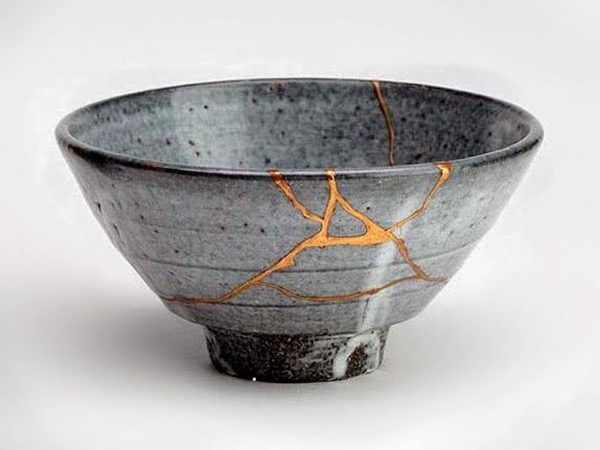
Kintsugi and the art of making repair visible - Austin Kleon
Example of Kintsugi art piece
This past week, I heard an online discussion on the Veritas Forum (http://www.veritas.org/) that helped me learn for the first time why lament might be so important—why lament might actually be GOOD. During the forum, the well-known artist, Mako Fujimura used the Japanese art form called Kintsugi to illustrate how people might need to process what we are currently experiencing with COVID19. Kintsugi is the art form of taking a broken piece of pottery and reassembling it using gold or silver lacquer in the cracks to cement the pieces back together. The result is actually something that can be more beautiful and valuable than the original unbroken piece. But the key, says Mako, is to differentiate between simply fixing something as opposed to crafting and transforming it with new beauty and purpose. In the Kintsugi tradition, in order to make something new that is truly a new work of art, you literally must hold on to the broken pieces for a significant amount of time to study them and get to know their shapes well before proceeding. Making the link with real life, Mako went on to suggest that is exactly what lament is—a period of time to embrace and fully grasp the brokenness that exists.

I have to admit this idea is very foreign to me. I’m a fixer. I like to repair things in the fastest and most efficient way possible. Just ask my wife about the countless times in our 43 years of marriage when she shared a hurt or an emotional wound and instead of identifying with her and trying to feel her pain, all I wanted to do was fix the situation as quickly as possible. That’s why the idea of taking time for lament is not natural for me. Nor do I think it is natural for our modern society in general. Most of what I hear in response to this pandemic (besides who to blame for it) is how to “fix” things as quickly as possible so as to get back to “normal” again.

However, just like at the first Good Friday, there may not ever again be a “normal” the same way we thought there should be. And maybe the “new normal” that will result is going to force a totally new way of thinking about ourselves and our world in order to carry on.

It’s easy for us with our historical hindsight to quickly pass over the anguish, grief, and lament that Jesus’ followers experienced during the hours that immediately followed the crucifixion. We love to shout out that phrase, “It’s Friday, but Sunday’s coming!” because we love to focus on the glorious image of Easter morning with the empty tomb and the victory over death it represents. After all, why wallow in despair and darkness when we know the joy and brightness of the “end of the story?”
But is it possible that experiencing a season of true lament is actually needed in order to more fully appreciate and embrace whatever “new normal” the future may hold? Just like the longer a Kintsugi artist holds the broken pieces of his pottery, the more beautiful he or she will be able to transform it into new work of art, so should we fully grasp the brokenness of this coronavirus moment in order to consider how we could emerge more sensitive, caring, and more fully human than ever before.

So, if there is anything that the story of Good Friday has to say to us on this particular April 10, 2020, it’s that lament can be GOOD after all!

Sunday, April 5, 2020

Palm Sunday, Crowns, and the Coronavirus

Palm Sunday Prayer and Call to Worship Ideas | Faithward.org
Today, on this Palm Sunday, I have been asking myself this question: Why did Jesus plan and go through the triumphal entry experience commemorated by this day? Was it because he wanted people to have an opportunity in recognizing him for who he really was – the Messiah, the King, their Lord? Or was it because he wanted to do something that would finally tip the scales with the religious authorities and trigger the ultimate events of Holy Week? 

Perhaps these are both correct. But, might there be an even deeper significance to this day that God wanted to use in order to contrast two very different perspectives that resulted from Palm Sunday versus Easter Sunday?

Consider the following:
  • ·         The people welcoming Jesus on Palm Sunday were doing so because they saw him as the Messiah—a savior and a solution to their political bondage and frustrations.  They were ready to offer him a crown of a ruler in the way they understood the concept of kingdom. It was to be a kingdom where they (as common people, Jewish citizens, etc.) had everything to gain and nothing to lose. In a sense, they wanted to offer Jesus a crown while keeping the crowns of their own private, personal kingdoms. No wonder they were excited: It would have been all gain with no pain!
  • ·         In contrast, God unfolds his Eternal plan of salvation through circumstances very different from those expectations. His Son is betrayed, maligned, rejected, and ultimately crucified. The sign nailed on the cross "King of the Jews" is put there not in honor, but in derision. Instead of the type of crown the people were ready to give Jesus on Palm Sunday, he now wears a crown of thorns--a symbol of the price paid for experiencing the horrific rejection of both mankind and also, for a time, of God the Father.
  • ·         On Easter Sunday, however, exactly one week later, Jesus rises from dead as the true King, not only of the Jews, but King of Kings. In stark contrast to the hope and expectations people had a week before, now to acknowledge his Kingship, as well as his being Messiah and Savior, there is a cost involved. Another way to say it is in order to crown Jesus with the crown he deserves as King of Kings, one must first experience the costly acknowledgement of personal sin, repent of that sin, and humbly accept the forgiveness, redemption, and restitution he offers. In other words, one does indeed have much to gain, but only first by experiencing the pain of losing his or her own personal crown.
  • ·         Therefore, a Palm Sunday "Messiah" seems to represent a two-kingdom solution to what was a temporary, local dilemma, whereas Easter Sunday’s "King of Kings" represents a one-kingdom solution to mankind's ultimate dilemma of sin and eternal salvation.


Relating this to the Coronavirus
Coronavirus emergency: here's what we know so far - Ecobuild.club 
Wikipedia offers this following definition: The name coronavirus is derived from the Latin corona, meaning "crown" or "halo.” This is due to the crown-type appearance of the virus when viewed under an electron microscope.   

It is interesting that in the midst of this current pandemic, the coronavirus has indeed taken on the symbolic crown of a "king" that has totally dominated the world and ruthlessly exerted its power of life and death over all mankind. As we witness how most people view these events, it seems evident that most would simply like this situation to go away quickly so that all can go back to normal again. It’s easy to see how people don't like how the coronavirus has exerted a one-kingdom domination forcing them to give up their own personal "crowns" and kingdoms of comfort and self-reliance in order to be subservient to laws of isolation, containment, and survival.

The displeasure of being de-throwned from their personal kingdoms is further illustrated by the popular  tendency to 1) try to find who to blame (Chinese, Trump, federal government incompetence, etc.) and 2) wanting to get back to "normal" as quickly as possible. All of this is evidence of desperately wanting to maintain a two-kingdom world.  In other words, God or the coronavirus can do whatever they like, as long as it doesn't overly impact my own personal kingdom.

In 2 Chronicles 7:13-14 God says to his people: When I shut up the heavens so that there is no rain, or command locusts to devour the land or send a plague among my people, IF my people, who are called by my name, will humble themselves and pray and seek my face and turn from their wicked ways, then will I hear from heaven and will forgive their sin and will heal their land.

Is it possible God has sent this world-wide plague in the context of 2 Chronicles 7? Is it possible He wants to get the attention of people who are so caught up in their two-kingdom worlds that they can't possibly conceive of the fact that God created the universe to run as a one-kingdom system? Like C.S. Lewis says in his book, The Problem of Pain, is it possible God is using the pain of this coronavirus pandemic as his “megaphone to a deaf world?”

I have to admit that during most Palm Sundays, I have focused primarily on the joyful image of Jesus riding on a donkey, prophetically portrayed as our future King and highlighted by children marching into church waving palm branches and singing “hosanna” songs.  I have not ever thought about it as a possible object lesson God might have planned to contrast my preferred gain-with-no-pain, two-kingdom world with his gain-through-personal-repentance, one-kingdom world of Easter Sunday.

And since this particular Palm Sunday occurs smack in the middle of a worldwide pandemic, what additional lesson does God want me to learn from the way He could be using the coronavirus as a personal call back to a 2 Chronicles 7 response of humility, prayer, and confession?  

I guess I definitely have no excuse about having enough time to think about answers to these questions!

Monday, December 2, 2019

Advent Adventure

Last Sunday, Anita and I had the privilege of initiating the Advent season at our church by lighting the first candle of the Advent Wreath with the special help of all four of our grandchildren. Before the official candle-lighting, I had the chance to review with our congregation some of the history and meaning of this tradition.

Most remember that the roots of today's Advent tradition go back to the early days of the Reformation when Martin Luther and other church fathers sought practical ways to make the Gospel message clear and meaningful, especially to children. Along with the Christmas Tree, the Advent Wreath was a great way to teach such things as the circular wreath being a symbol of Eternal Life as well as a royal crown for King Jesus, the prickly holly a symbol of His crown of thorns, the pine cones of rebirth and new life, the candles of God's Word lighting the darkness, etc., etc.

But as I reviewed what to share at church, there was a new aspect that I had not thought about before. It had to do with the Latin word from which we get the English advent.The word is adventus which means arrival or coming. What I learned, however, is that the etymology of adventus shows it is actually made up of advenio (arrival) and tus (a suffix that turns it into an action noun.) This means that the concept of advent is not a ho-hum type waiting, like waiting for the school bus to arrive. It is a much more active involvement, like sitting on the edge of your seat with great expectation. Think of the word adventure, which is also derived from the same Latin root. You embark on an adventure with great expectation that something exciting, unexpected, and remarkable might lie ahead.

Another great way to capture this concept of active waiting is to think of the five candles on the Advent Wreath as similar to a NASA countdown toward a rocket launch: 5-4-3-2-1. . . Every second ticked away brings you closer to the exciting climax of a BLASTOFF! In the case of the wreath, the five candles count off the weeks toward the celebration of the most remarkable event in all of human history--the arrival of the Christ Child, Emmanuel, God-with-us! And just like NASA uses countdowns to remember critical action steps in a rocket launch sequence, so too, the five candles provide important reminders of what Christ's coming means to us. The first candle is the Prophesy Candle with a focus on the Hope the prophets told us about. The second is the Bethlehem Candle with a focus on God's Love demonstrated by the incarnation. The third is the Shepherd's Candle with a focus on Joy, since they were the ones who heard the "tidings of great joy." The fourth is the Angel's Candle with a focus on Peace, from the announcement of "peace on earth, goodwill toward men." Finally, the last one is Christ's Candle, lit on Christmas Eve when we celebrate His coming as God's Light to a dark world.

Just like the Advent Wreath is a great exercise in waiting expectantly for the celebration of Christmas, it is also a wonderful reminder that we all still live in the tension of waiting for Christ's Second Coming which is still in the future. May all of our waiting for that ultimate event be an active adventus-type waiting with readiness and great expectation--since without doubt, God definitely has more ADVENTURE waiting for all of us ahead!

Merry Christmas
Jon Lewis